
Stop Being a Gamble: Why Tattoo Clients Pay More for Certainty Now
Dec 04, 2025
Stop Being a Gamble: Why Tattoo Clients Pay More for Certainty Now
By Chris Toms "Tattooer Entrepreneur"
If your client flow has felt like a slow-motion car crash over the last two years, you’re not alone. The market is contracting, and it’s not just a seasonal slump—we're in an economic gravity well. The "tattoo recession" is real, and it’s fundamentally reshaping our industry.
The critical question is: Why are some artists weathering this storm with relatively full books, while the majority are reporting crippling client flow drops exceeding 50%?
The economic squeeze is forcing clients to make rational, risk-averse choices, and those choices are sending them directly to the established, premium brands. Where we are now is the exact opposite of when the stimulus money was flowing: when people have more disposable income, especially from money they didn’t work for, and inflation is at normal levels, their risk taking is a lot higher. This contraction isn't just about less money; it’s about a severe market polarization. Here’s a breakdown of the structural shifts and the behavioral economics that explain who's thriving and who's getting squeezed.
The solution to this problem is fixing your position in the market.
I. The Core Problem: Saturation Meets Economic Squeeze
The struggle facing most artists is a collision of two unchangeable forces:
- Market Saturation: The low barriers to entry mean the market is flooded with generalists, making it hard for any single artist to stand out on talent alone.
- The Economic Filter: Tattooing is a luxury, non-essential service. Persistent inflation over the last few years has devalued the dollar, forcing clients to scrutinize every discretionary purchase. This financial pressure makes the client extremely risk-averse.
The artists who are struggling are often those who haven't built a defense against either of these forces.
II. The Client's Calculation: Risk Aversion and the Research Deep Dive
The client base that is still spending is behaving differently. While some clients are still commissioning high-value, multi-session work, many others are shifting toward smaller sessions and more budget-friendly, single-sitting pieces. They are not looking for a deal; they are looking for certainty.
The decision to choose a proven artist over a cheaper, less experienced one is an act of rational financial hedging. It’s all about the long-term cost of failure, which is magnified by the client's Loss Aversion—the desire to avoid the pain of a bad outcome.
The New Client Research Funnel
When money is tight, the client’s purchasing process shifts from impulsive browsing to deep investigation. They are actively seeking to eliminate regret by vetting every potential risk.
- Portfolio Scrutiny: The risk-averse client is looking for proof of consistency. They scroll deep, specifically looking at healed work and high-detail close-ups to confirm the artist's technical reliability.
- Review Validation: They are looking for qualitative evidence that the artist is professional, clean, and reliable. They search for mentions of smooth booking processes, good communication, and positive practice experiences, as these are all signals of low logistical risk.
- Specialization Search: They are not searching for "tattoo artist near me." They are searching for the specific style the established artist has cornered, reducing their pool of options to only the confirmed experts.
For the Struggling Artist: A low initial cost is often perceived as a high risk of poor execution, leading to the expensive, stressful liability of correction or removal. Correction costs typically exceed $1,000+ over time.
For the Thriving Artist: Their premium price is an insurance policy. The client willingly pays a "risk premium" to guarantee the desired outcome and mitigate the financial and emotional pain associated with Loss Aversion.
In an economy of intentional spending, the thriving artist’s robust online footprint serves as the necessary, monetizable evidence of quality. Trust is the critical commodity that the booked artists possess.
III. The Real Difference: Established Brand Identity
The reason some artists are doing fine while most are struggling is not just about raw talent—it's about their established brand identity and structure.
Artists who have been in the industry a long time with an established client base are naturally doing better. And here’s the important part: That established brand is in full swing. The clients who are still spending are choosing the artist that represents the lowest risk of disappointment.
- The Thriving Artist's Advantage: Their success is built on a seamless, professional, and consistent brand structure. They've transitioned from being a talented practitioner to being a reliable business—a known quantity.
- The Struggling Artist's Flaw: Their pages are often a mess—no clear brand identity, just the same grid posts often saying they have availability. They are seen as a gamble because their business structure lacks the signals of stability and quality that the risk-averse client is now demanding.
IV. Market Polarization: The Squeezing of the Mid-Tier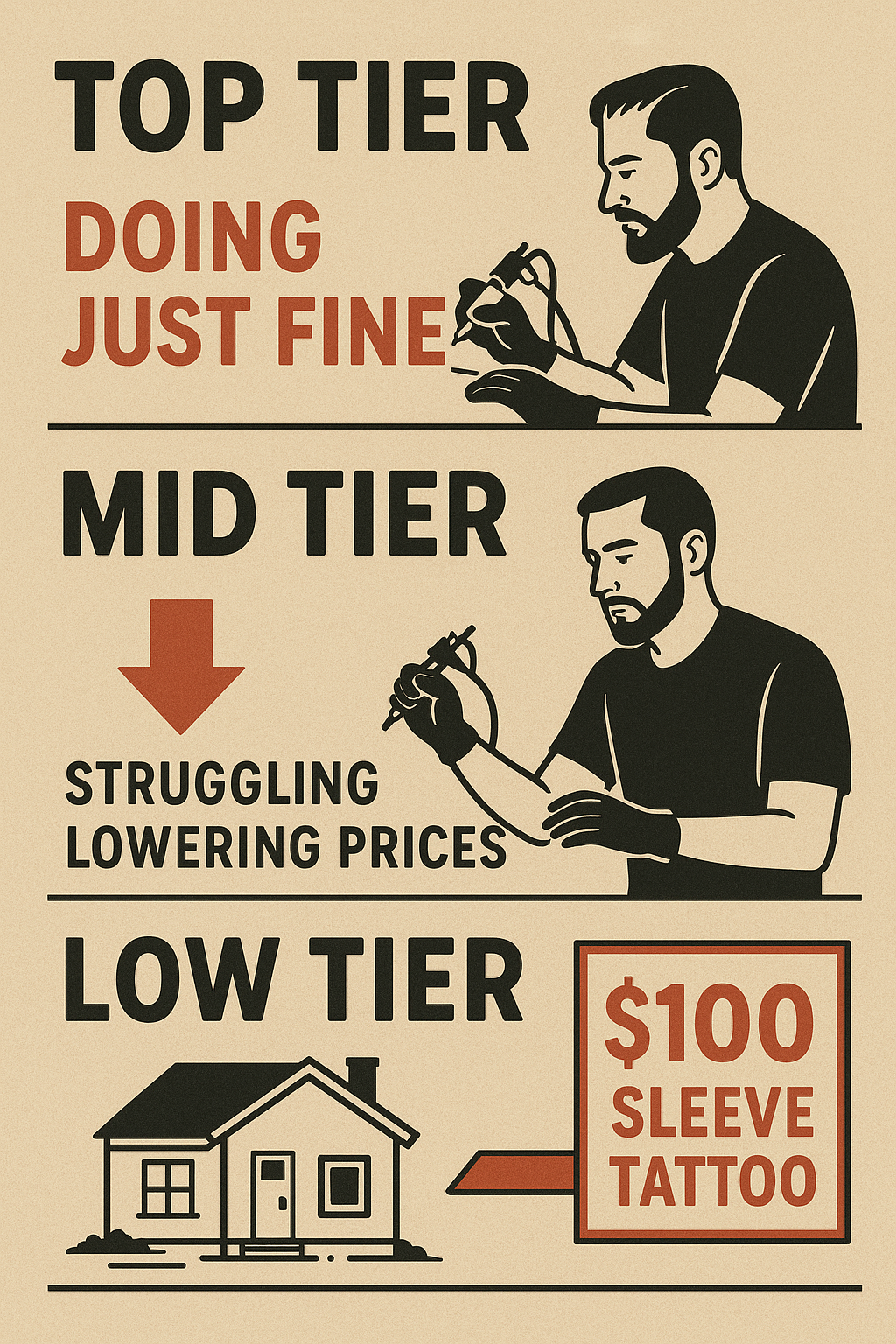
The recession is not shrinking the market evenly; it is consolidating it into two distinct poles:
|
Segment |
Typical Artist/Setting |
Primary Client Motivation |
Survival Outlook |
|---|---|---|---|
|
Premium/Established |
Specialized Private Practices; Veteran Artists |
Certainty, Investment Value, Low Regret Risk |
High Resilience (Stable high AOV) |
|
Commodity/Volume |
Scratchers; Low-Overhead, Unregulated Work |
Immediate Consumption; Absolute Lowest Price |
Resilient (High volume, low AOV) |
|
Mid-Tier/Generalist |
General Walk-in Shops; Non-Specialized |
Convenience; Moderate Quality, Moderate Price |
High Vulnerability (Caught between extremes) |
The segment getting crushed is the mid-tier generalist. They cannot compete on price with the accelerating low-cost market, yet they lack the brand clarity and structural stability to compete with the premium end. Without a defined niche or a reputation for a specific, high-quality service, their value proposition evaporates when consumers are forced to scrutinize every dollar.
In summary: The answer to why some are thriving while most are struggling boils down to this: In a risk-averse economy, the artists with a strong, established, specialized, and trusted brand are perceived as a guaranteed investment, while those without one are seen as a gamble. Their competitive edge is structure and professionalism, not just raw talent. The path to stability is strategically fixing your position in the market by becoming the specialist, building your brand around your business, and generating undeniable trust.